

Time Perception as an ADHD business owner
How time-blindness can effect your perception, and income.

It Only Took a Few Hours, Right?
Recently, I worked with a client to systemize part of their business. It wasn’t a huge project, just something to help them reduce manual work and streamline a few repetitive processes.
At the end of it, they said something the rubbed me the wrong way:
“I just don’t feel like you did very much. Could we talk about a discount?”
Oof. It wasn’t meant to be malicious. It wasn’t rude. But it did sting because my gut reaction was to feel under-appreciated.
After a bit of thought, I realized it revealed something deeper.
It’s not that the client didn’t value the outcome. They loved the result. It’s that they didn’t see the work it took to get there.
That’s not really their fault.
This kind of misunderstanding happens all the time, especially when you work in systems, strategy, or anything that’s basically invisible.
For me, as someone who’s both a consultant and an ADHD entrepreneur, this moment was even more painful.
Because it showed me (again) how invisible work and time blindness can get in the way of real understanding and therefore making a living.
Time to “unpack” this little conundrum
Let’s take this hypothetical project and actually map out where the time went.
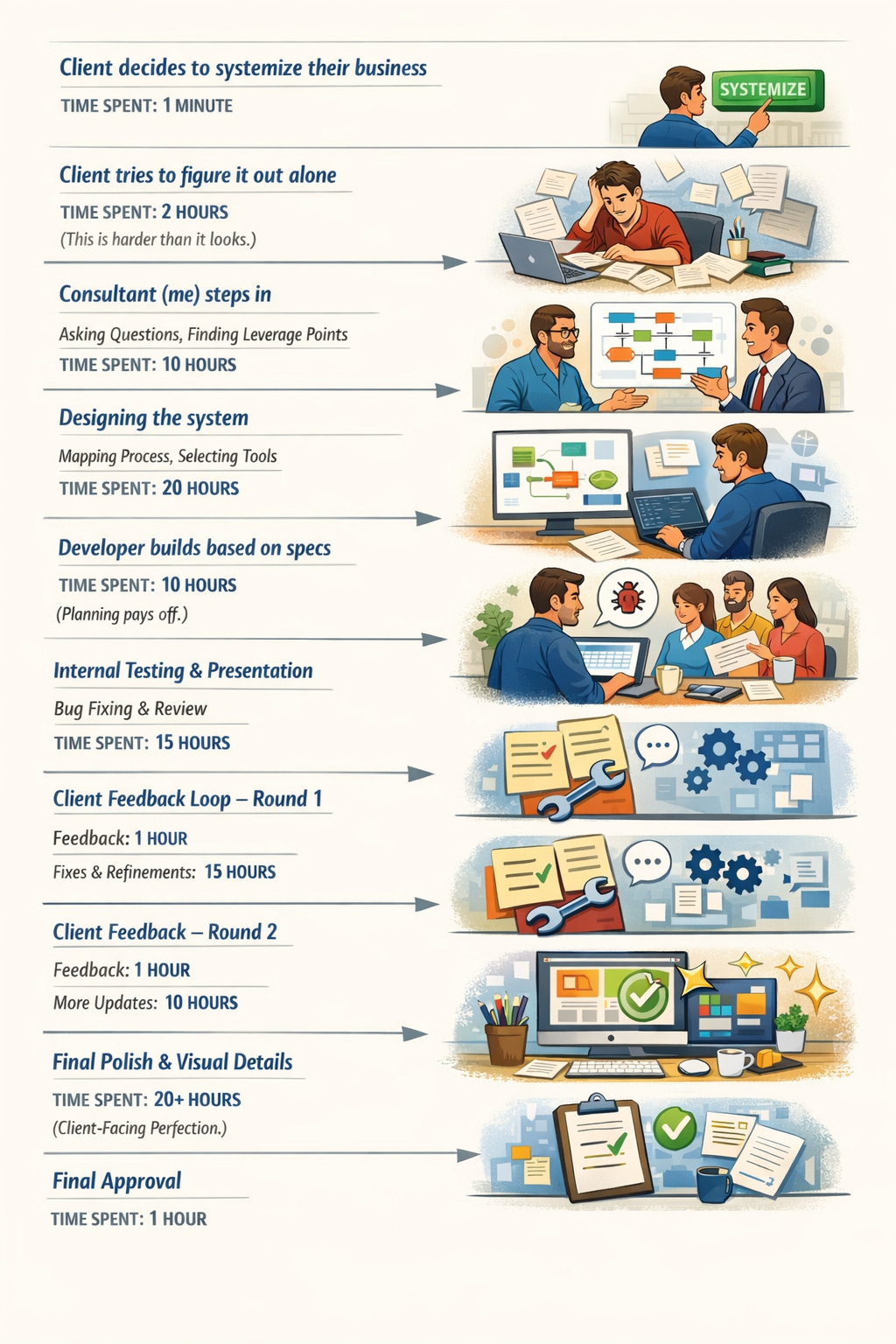
Client decides to systemize their business
Time spent: 1 minute (Huge step, even if it’s a fast one.)
Client tries to figure it out alone
Time spent: 2 hours (They realize quickly: this is harder than it looks.)
Consultant (me) steps in
Asks deep questions, understands their operations, identifies leverage points
Time spent: 10 hours
Designing the system
We map out the process, select the right tools, and coordinate with the team
Time spent: 20 hours
Developer builds based on specs
Time spent: 10 hours (Only goes this fast because… planning.)
Internal testing and presentation
We catch bugs, polish things, prepare it for client review
Time spent: 15 hours
Client feedback loop -- round 1
Feedback: 1 hour
Fixes and refinements: 15 hours
Client feedback -- round 2
Feedback: 1 hour
More updates: 10 hours
Final polish and visual details
Time spent: 20+ hours
(Especially important if client-facing.)
Final approval
Time spent: 1 hour
The Result?
The client now saves 20 hours per month
That’s 240 hours per year, a full month of time they get back, every year.
That’s massive.
But the perception?
“Didn’t seem like that much work.”
Let’s talk about why that happens, especially in the context of ADHD and productivity.
What ADHD Teaches Us About Value Perception
I’m not here to diagnose clients, but as someone with ADHD who works with a lot of neurodivergent entrepreneurs, I see the patterns clearly, both in myself and others.
There are 3 big dynamics at play here:
* * *
1. Time Blindness Is Real -- For Everyone Involved
People with ADHD often struggle with time perception. We might underestimate how long something takes, or forget how long we’ve already spent.
While this is something we can talk about in depth as far as tools to help prevent or utilize time-blindness effectively, I really wanted to talk about how this works when YOU are the client, or you are looking to purchase time from another individual.

This is also applicable if you are a neuro-spicy small business owner in the small business space, just from the other angle.
As a client, when someone doesn’t witness the work, they assume it didn’t take long.
Especially if the outcome is smooth and seamless “easy” in appearance.
If it looks simple, it must be simple, right?
Nope. Simplicity is expensive. It’s a result of thoughtful, layered work -- and hours of hidden decisions.
Yes, my business is called “Ana’s Simple Solutions” but that’s not because what I do is simple, it’s because the things I offer simplify my customer’s lives.
For ADHD entrepreneurs, this can be a double whammy:
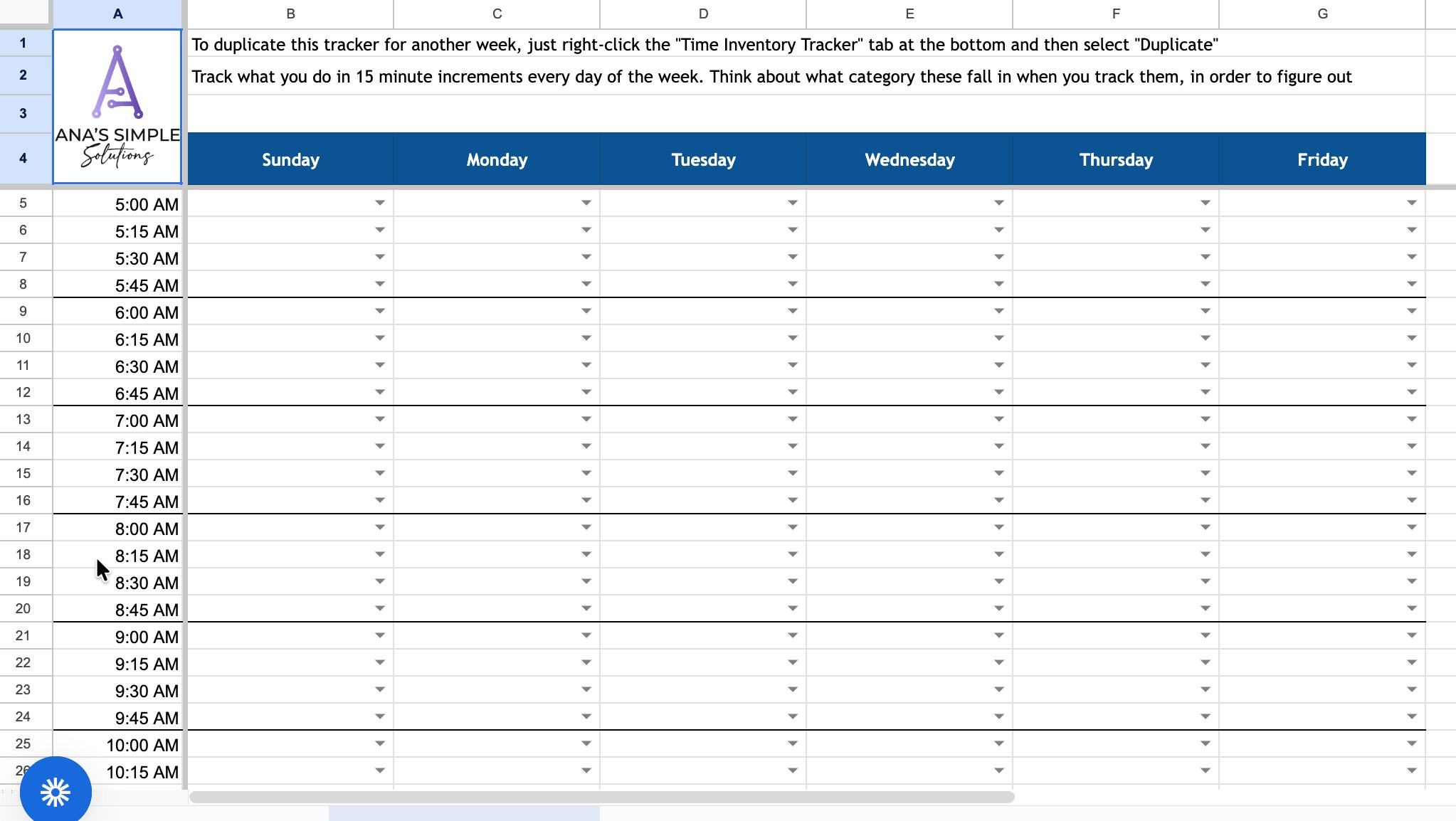
We don’t always track our time accurately. In fact, tracking time at all feels extremely heavy and annoying.
We often under-report how much effort we spent. (Raise of hands who did this just last week... yep, me 🤚🏻)
And we forget that clients can’t see inside our brains
So how do we change this pattern?
💡 Idea: Start externalizing your time. Track it for yourself first, so you know the real investment. Then share it strategically with your clients not to defend your value, but to help them understand it.
(Here’s a free one… It’s in google sheets, but it works great if you are so inclined, you can also use a tool like Toggle or Clockify)
🔗 https://www.anasimplesolutions.com/time-tracker/
My Airtable time-tracker is also cool if you are an airtable user.
2. Invisible Work Creates Invisible Value
The work I love most problem-solving, process-mapping, backend logic that isn’t flashy. It happens in workflow boards, behind the scenes, in long quiet sessions where I untangle chaos and build clean, elegant flows.
But to the outside world?
That’s not “work.”
That’s “thinking.”
Or worse, “nothing.”
This is especially tricky for ADHD folks, because many of us can feel guilty or unproductive when we aren’t visibly “doing”.
Our knowledge, everything we’ve gained from years of having multiple interests and passions... are not valuable.
We also tend to:
Struggle to explain what’s happening internally
Skip documentation because it feels boring or redundant
Figure that if we assume things, then everyone must also assume things.
So the real work gets buried under “just a few hours of changes.”
💡 Idea: Build a habit of narrating your process, not in a defensive way, but in a teaching way. Create a timeline. Share progress checkpoints. Build a visual of what’s been done, even if it feels obvious to you.
3. It Takes Time to Make Time
This is the hardest part to explain to clients and often to ourselves, even if we innately know it:
Systems don’t save time immediately.
They save time eventually.
And that eventual payoff.... is exactly why we do it.
If I spend 50 hours building a system that saves you 20 hours a month…
You’re getting a 4:1 return in year one, and that ratio keeps improving over time.
But if you’re focused only on the initial investment, it feels heavy. Or unnecessary. Or overpriced.
This is especially common in ADHD businesses, where things that are “Important and Urgent” supersede anything that requires planning or is “Important and Not-urgent”
Also prevalent is when we avoid structure because it feels constraining and we want to “just get through the day,” not build for the future.
So, here’s the secret, even though our brains rebel against it, systems and habits are the ONLY things we can do or create for ourselves to make us feel like we are able to “keep up” with the pressures of modern life.
Also, if things are systemized, it creates more room for the creative ideas and hobbies you feel pulled to do.
💡 Idea: As a service provider, position your work as a long-term asset. As a business owner, learn to see systems as a gift to your future-self -- not just an admin cost.
What I’ve Learned (The Hard Way)
I love ♥️ doing the work.
I love ♥️ solving problems.
I love ♥️ making messy businesses feel clean and clear and calm.
But I’ve learned that none of that matters if the client doesn’t understand what went into it.
So now, I’ve created habits and systems to:
✅ Track my time
✅ Visualize my process
✅ Share progress in clear, non-technical ways
✅ Systematize how I show my work
Because perception is part of the value.
And visibility is part of the deliverable.
If you’re neurodivergent -- or you work with folks who are -- remember this:
People can’t value what they can’t see.
And sometimes (all the time?) neither can we.
Final Thought

It takes time to make time.
Whether you’re the one hiring help or the one doing the work, know this:
You might be investing 50 hours now
To buy back 240 hours later
That’s not inefficiency.
That’s leverage.
That’s being effective.
And if that’s not valuable, I don’t know what is. 💸💰🤑
If this resonated, and you are looking for more helpful tools, please check out my shop here with helpful Templates created to organize and systemize for those with ADHD.
🔗 https://www.anasimplesolutions.com/shop
Externalizing is the key to so many of my ADHD woes! And timeblindness is one of them for sure.
Interesting post. I hadn't considered how timeblindness adds to the already tricky situation of pricing/valuing the work you do in a business.
As for clients, it seems the best way to position any service/product/goods is to talk about the value to the client, not how much time you as the consultant/service provider spent on it. It's not something that comes intuitively. I come from an industry where everything is paid by the hour and now its really coming to a head with AI seemingly making everything "instantaneous." I feel we've been approaching pricing completely wrong. (Sorry, I digress - but your post got me thinking in a different direction - which is the sign of a great post!)
Thank you for sharing!
This nails the invisible labor problem. The client story about asking for a discount really hit me, I've been on both sides of that conversation. The time blindness piece is especially tricky becuase the better the system works, the less effort it appears to take. People pay for the outcome but can't see the 100+ hours of problem-solving that made it look effortless.