
The Recipe for an ADHD-Friendly Task System
How to Stop Using Your Brain as a Storage Unit

TL;DR for my neuro-spicy brains
If you’ve ever abandoned a beautiful planner, “solve it all” digital app, and blamed yourself, this is was written for you
Paper systems are static.
They may be pretty, or motivating… but they don’t flex with your brain or your energy.
ADHD brains are dynamic.
A digital system works better not because it’s fancy, but because it adapts.
The goal isn’t to become more disciplined.
It’s to build something that supports your brain on its lowest-capacity day.
Before We Start: A Confession
I love a beautiful planner.
I love the clean pages. The matching pens. The feeling of writing out a fresh Monday with perfect handwriting and big intentions.
I have a whole bookshelf dedicated to notebooks with different kinds of paper ready to use or create a beautiful bullet journal.
There is something deeply hopeful about a brand-new notebook or planner
And I have abandoned more of them than I care to admit.
(I’m sure I’m not the only one)
Not because I didn’t care.
Not because I wasn’t trying.
But because by Wednesday, something had shifted.
A client moved a deadline.
A kid got sick.
My energy tanked.
I underestimated how long something would take (again).
My life didn’t fit neatly into it’s time-blocked structure and it blew my nicely laid paper plans out of the water.
And suddenly the neat, structured week I had laid out felt like a silent judgement, which makes me abandon it altogether.
You were doing so well. What happened?
Here’s what happened: LIFE. ADHD brain. KIDs. Other people with their own agendas.
Paper planners assume consistency.
ADHD brains operate on variability.
I finally stopped trying to force a static system onto my dynamic brain. I had to figure it out on my own, in a way that could actually work for others in my life too.
So if you’ve got your own planner graveyard, keep reading. Let’s make something better.
ADHD-friendly task system - the recipe
(Serves: One overwhelmed entrepreneur managing both business and life)
Ingredients for success
A digital platform that can hold everything
(I prefer Airtable and my home-grown template but you can use a plethora of tools, but make sure they are flexible). Other options include: Notion | ClickUp | TrelloA willingness to stop blaming yourself for being “so disorganized”
One place for every task to land
Filters (this is important) to help categorization
A recurring task feature
The willingness to create a habit to use it
Optional but recommended:
A healthy skepticism of aesthetic productivity culture.


Step 1: Stop Storing Things in Your Brain
First, we empty the mental junk drawer.
ADHD brains struggle with working memory. That constant low-level “What am I forgetting?” hum is exhausting.
So instead of trying to remember:
Follow-ups emails
Appointments for the entire family
Client deliverables
School deadlines
Random 10:47 p.m. ideas right as you are trying to fall asleep
You put them somewhere reliable.
One… not 5. (Sticky-note people, I’m looking at YOU!)
This is your digital home base. Your command center. The place you check instead of scanning your brain.
The magic isn’t the tool. It’s the consolidation.
I know people that speak into their voice notes whenever something comes up and it ends up in their Project Management or Task management tool.
Now THAT’s using technology wisely.
Step 2: Make It Move
Here’s where digital rock really beats paper.
If Tuesday implodes (and it will), you don’t cross out half a page and rewrite your life.
You drag tasks.
You reschedule.
You adjust.
Your family/teammates find out instantly without you having to create another communication to them.
Paper is, “Here was the plan.”
Digital is, ”here’s the plan on a moving target”
That flexibility removes so much shame.
Because the system moves with you instead of quietly recording your inconsistency.
Step 3: Filter Ruthlessly
One of the biggest reasons ADHD brains avoid task lists is visual overwhelm.
If I open my system and see 47 tasks, I throw up in my mouth a little.
So we filter into bite-sized chunks.
Show me today.
Show me this week.
Show me what’s waiting.
Show me what actually requires my energy right now.
Digital tools allow you to change your view without changing your reality.
You’re not ignoring the rest. You’re just narrowing your focus. It’s not avoidance, it’s prioritizing the things that matter and reducing the distraction your brain will always bring up at the most inconvenient times.
.
Step 4: Automate the Boring Stuff
Recurring tasks should not rely on memory.
Bills.
Content cycles.
School reminders.
Weekly planning.
Laundry (soooo much laundry)
If it happens every week or every month, make sure the system regenerates it.
ADHD doesn’t struggle because we don’t care.
We struggle because we’re trying to manually track too many repeating responsibilities.
Automation is not laziness.
It’s intelligent scaffolding.
Automate everything that you can.
Step 5: Separate Planning From Doing
(This is not specific to digital tools, but using this with digital tools makes life a lot easier)
There is a difference between:
Brain-dumping everything.
Planning the week.
Executing today.
Paper tends to blend those together onto one page.
Digital lets you create modes of operation, based on your energy and your brain strength for the day.
1. Planning mode.
2. Focus mode.
3. Review mode.
You don’t need to look at your entire life every time you sit down to work.
You just need to know what’s actionable now.
If I didn’t do this, I’d replan every single day and spend most of my time “spinning” in what I COULD do, rather than actually getting things done.
And though that still happens sometimes, because I am an adhd human, it happens a lot less now that I have a good idea of which Mode should happen when.
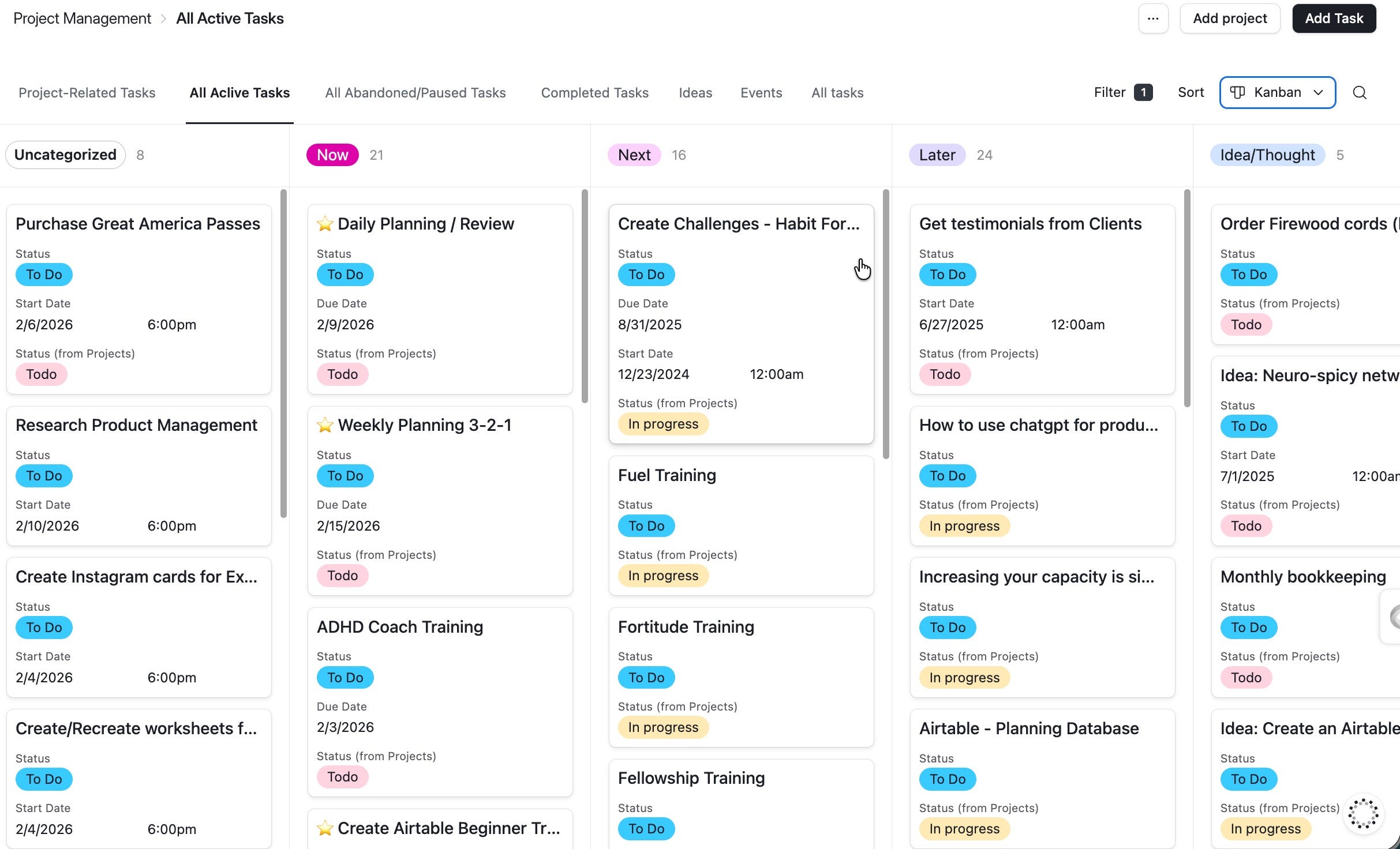
This is a picture of my own task manager, organized by “Now, Next and Later” to help figure out what I should be working on.
Step 6: Integrate Business and Life (Because They’re Already Mixed)
If you are running a business and a household, or even working with a business, you are managing two operating systems at least.
Without a digital hub, you are constantly context-switching in your head.
What happens when we context switch? Brain freeze.
Client call.
Lunches.
Invoice.
Dentist.
Marketing idea.
Grocery list.
Soccer practice.
A digital system lets you hold both worlds in one structure, even if you view them separately.
Even this helps your nervous system regulation.
Serving Suggestion
Use daily.
Adjust as needed. (or to taste)
Ignore anyone who tells you the “right” way to plan your week. (Although following ideas or well-meaning advice to try it for yourself is definitely encouraged.
If paper works beautifully for you, keep it. Who am I to try to complicate your life if it’s already working.
But, if you keep buying planners and quietly abandoning them, maybe the issue isn’t your discipline.
Maybe, you need a dynamic system for a dynamic brain.
That’s ultimately why I built Simplify & Conquer inside Airtable and ClickUp. (my two favorite digital tools for life-management).
Not to make something aesthetic.
But to create a digital command center that adapts when life does.
Because life will shift midweek.
Your energy will fluctuate.
Your capacity will change.
Your priorities will evolve.
Your system should be able to move when you do.

Final Thoughts From the Office
Just to reiterate, you are not disorganized, your are overloaded
For years, I thought the answer was better discipline. A “more perfect” planner. A stricter routine. Waking up earlier. Trying harder.
Basically burning out.
Trying harder is not a system.
You are already doing cognitive gymnastics daily. Expecting your brain to also function as a storage unit, reminder app, project manager, and calendar is… ambitious.
Digital tools aren’t about being “techy.”
They’re about externalizing executive function.
They hold what your brain shouldn’t have to.
They narrow your focus when everything feels loud.
And most importantly, they don’t shame you when you miss a day.
If you’ve quietly internalized the belief that you’re bad at planning because you can’t stay consistent inside a static system… the issue isn’t you.
You need a system built for variability and build momentum that actually lasts.
I’d love to know if this is something you’d like to know more about. How I manage my life and my days within my preferred digital tool and examples of the variability that can happen and it can absorb.
I am an action-taker and a problem solver by nature, and if what I’ve learned can help someone else, I’d love to share it.