

My planning framework - from the biggest to smallest

Hey friends,
Confession time: I am a chronic planner.
Not in the organized, color-coded, everything-in-its-place way.
In the I-have-seventeen-ideas-and-want-to-do-all-of-them-right-now way.
Planning, for me, has always felt exciting at the start and quietly defeating by midweek.
When I was running my own consultancy, my to-do list became something that I was passionate about on Monday, and avoiding on Friday.
Tasks piled up fast.
Half of them had no context.
The others kept getting pushed to next week, then the week after, then into a vague someday that never arrived.
There was no prioritization. No way of knowing if finishing a task actually moved anything forward. Just a longer and longer list that made me feel busy without making me feel effective. (the anti-productivity-person)
Eventually, I stopped asking "what do I need to do?" and started asking "what actually matters to me?"
My values, family, effectiveness, honesty in relationships, usefulness over performance, those aren't abstract ideals. They're a filter.
I had a coach a few years back that did a lot of work on values and how they relate to running a business… but it’s not just a business that values can help
When I finally got clear on what my values were, I could finally look at my project / task list and ask myself if it had to do with something I actually care about?
Most of the time… it was a big fat no.
I realized a lot of what I put on my plate was to make other people happy. The fundraising activity I signed up for, the errand I ran for a neighbor, the cupcakes I had to make from scratch for my son’s birthday.
The goals and projects worth keeping are the ones that feed the things that actually matter to me. Everything else is noise that is just busy-ness
At that point, I started to put the planning together into time-blocks.
Yearly Planning
Quarterly Planning: (to support the goals of the year)
Monthly Planning: What behaviors that would get me to the goals
Weekly Planning: Three priorities for the week, no more.
Daily Planning: a zoomed-in view of what I can actually move forward on given my energy right now.
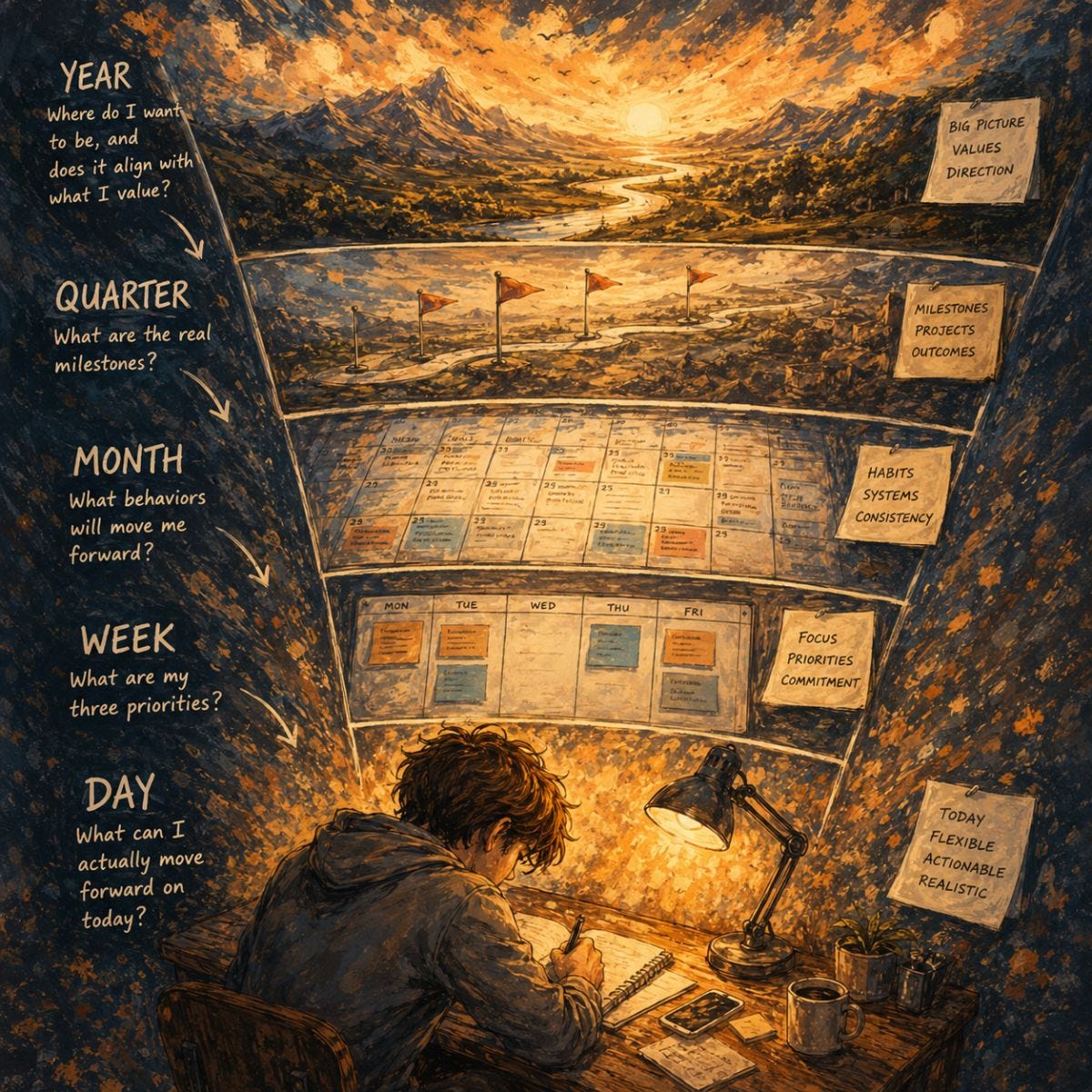
I call this the Zoom In Framework. You start at the widest view and zoom in until you land on something actionable today. Not aspirational. Not someday. Today.
The part I love the most is that the day level planning is flexible to work with your energy and schedule. (So super important for the neuro-spicy)
Some days you have three hours of deep focus. Some days you have forty-five minutes, with a sick kid at home and a headache.
Both deserve a plan and I made sure this planning framework works for both.
If your planning keeps failing by Thursday, it's probably not a discipline problem.
It's a connection problem. The tasks aren't connected to anything that actually matters.
And a disconnected task is just an obligation with no reason to exist.
💡 Productivity Tip of the Week
Make weekly planning a non-negotiable, and keep it short.
Once a week, before the week starts, sit down for 20 minutes. Review what happened last week. Reconnect with your bigger goals. Pick three priorities for the week ahead.
Just three.
The 20 minutes you spend Sunday evening will save you hours of reactive, unfocused work Monday through Friday. Highest-ROI habit in my whole system.
💬 Quote of the Week
"Plans are nothing; planning is everything."
-- Dwight D. Eisenhower
The plan will change, life guarantees that. However, the act of planning builds the thinking, the clarity, and the awareness of what actually matters.
Don't skip the process just because the output won't survive contact with reality.
🖊️ My Favorite Things
A good notebook and a pen you actually like writing with.
There's something about having a physical space to think that no app has ever fully replaced for me. When I'm doing real planning, not task management, but actual thinking about direction and priorities, still reach for paper first.
If you've been using whatever's lying around, treat yourself to something you look forward to picking up. It makes a difference.
(I recommend Pilot Dr. Grip Center of Gravity Retractable Ball Point Pen, Medium Point, Black Ink, Pack of 3 (Blue))
The complete Zoom In Framework, with all five planning levels, the questions to ask at each one, and how it connects to your daily task management, is in this week's paid post.
If you've been on the fence about upgrading, the planning framework is a good place to start. It's the foundation everything else in this system is built upon.
→ [Upgrade to read the full framework]
Dear Subscribers: Thanks for your support! I will continue to provide
free content on a weekly basis as long as “life” doesn’t “life” too much for me :)
If you gained something from this and would like to support my work you can: